Buying vitamin B: B-complex, B12 and folic acid
Vitamin B isn’t actually a single vitamin, but a whole group. There are eight B vitamins, and they are all water-soluble. You get them from your diet, for example from wholemeal products, pulses, vegetables, meat, fish, eggs and dairy products. If you eat a varied diet, you’ll often get enough of most B vitamins. Nevertheless, many people choose to supplement their diet with a vitamin B supplement, for example because they follow a vegan diet or simply want to be on the safe side.
At Golden Naturals, you can buy vitamin B as a complete B-complex, or as individual B vitamins. We stock vitamin B tablets, vitamin B12 lozenges and capsules, and all the vitamin B supplements on this page are vegan. Not sure which one’s best for you yet? Our selection guide will help you make the right choice in just a few steps. Have you made your choice? Then you can easily order your vitamin B supplements online and have them delivered to your door in no time.
A B-complex vitamin or an individual B vitamin?
A vitamin B complex contains all eight B vitamins in a single tablet. This is handy if you want to keep things simple. Are you looking for a specific B vitamin, such as vitamin B12 or folic acid? Then opt for a single supplement. If you’re taking several supplements at the same time, such as a B-complex and a multivitamin, add up the amounts of each B vitamin.
Which vitamin B is best? Here’s what to look out for
At Golden Naturals, we get this question all the time: what is the best vitamin B supplement? To be honest, there isn’t one single ‘best’ vitamin B supplement. It depends on what matters most to you. Good to know: vitamin B supplements differ mainly in four ways.
- Which B vitamins are in it: all eight, or just one or two?
- The dosage per tablet or capsule
- the chemical form, such as methylcobalamin or hydroxocobalamin in the case of vitamin B12
- Form: tablet, lozenge or capsule
Our range at a glance
The right dose for you depends on your personal circumstances. Always follow the recommended daily dose stated on the packaging.
What is vitamin B good for? A rundown of all the B vitamins
As vitamin B is a group of vitamins, each B vitamin has its own specific functions in your body. That is why the officially recognised health claims for each B vitamin are listed below. Good to know: a claim only applies if the supplement contains a sufficient amount of that B vitamin per daily dose. You can find out how much is in a product by reading the label.
Vitamin B1 (thiamine)
In supplements, vitamin B1 is often found as thiamine hydrochloride.
- Thiamine contributes to normal energy-yielding metabolism
- Thiamine contributes to the normal functioning of the nervous system
- Thiamine contributes to normal psychological function
- Thiamine contributes to the normal functioning of the heart
Vitamin B2 (riboflavin)
Our B-complex contains vitamin B2 in the form of riboflavin-5-phosphate.
- Riboflavin contributes to normal energy-yielding metabolism
- Riboflavin contributes to the normal functioning of the nervous system
- Riboflavin helps maintain healthy mucous membranes
- Riboflavin helps maintain normal red blood cells
- Riboflavin helps maintain normal skin
- Riboflavin helps maintain normal vision
- Riboflavin contributes to the normal metabolism of iron
- Riboflavin helps protect cells against oxidative stress
- Riboflavin helps reduce tiredness and fatigue
Vitamin B3 (niacin)
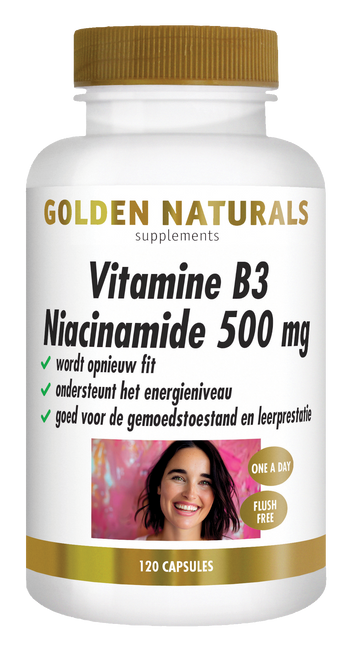
Niacin is the collective term for vitamin B3. Niacinamide is one of the forms of niacin. You can find it in our B-complex range and as Vitamin B3 Niacinamide 500 mg.
- Niacin contributes to normal energy-yielding metabolism
- Niacin contributes to the normal functioning of the nervous system
- Niacin contributes to normal psychological function
- Niacin helps maintain normal mucous membranes
- Niacin helps maintain normal skin
- Niacin helps reduce tiredness and fatigue
Vitamin B5 (pantothenic acid)
In supplements, vitamin B5 is often found as calcium D-pantothenate.
- Pantothenic acid contributes to normal energy-yielding metabolism
- Pantothenic acid contributes to the normal synthesis and metabolism of steroid hormones, vitamin D and certain neurotransmitters
- Pantothenic acid helps reduce tiredness and fatigue
- Pantothenic acid contributes to normal mental performance
Vitamin B6
Our B-complex contains vitamin B6 in the form of pyridoxal-5-phosphate. Another form you may come across in supplements is pyridoxine.
- Vitamin B6 contributes to normal cysteine synthesis
- Vitamin B6 contributes to normal energy-yielding metabolism
- Vitamin B6 contributes to the normal functioning of the nervous system
- Vitamin B6 contributes to the normal metabolism of homocysteine
- Vitamin B6 contributes to the normal metabolism of proteins and glycogen
- Vitamin B6 contributes to normal psychological function
- Vitamin B6 contributes to the normal formation of red blood cells
- Vitamin B6 contributes to the normal functioning of the immune system
- Vitamin B6 helps reduce tiredness and fatigue
- Vitamin B6 helps regulate hormonal activity
Vitamin B7 or B8 (biotin)
Biotin is known as both vitamin B7 and vitamin B8. It is the same vitamin.
- Biotin contributes to normal energy-yielding metabolism
- Biotin contributes to the normal functioning of the nervous system
- Biotin contributes to the normal metabolism of macronutrients
- Biotin contributes to normal psychological function
- Biotin helps maintain normal hair
- Biotin helps maintain normal mucous membranes
- Biotin helps maintain normal skin
Vitamin B11 (folate and folic acid)
Folate is the form found naturally in food. Folic acid is the form you often find in supplements. Our B-complex and Folic Acid Active contain folate in the form of 5-MTHF (Quatrefolic®).
- Folate contributes to the mother’s tissue growth during pregnancy
- Folate contributes to normal amino acid synthesis
- Folate contributes to normal blood formation
- Folate contributes to the normal metabolism of homocysteine
- Folate contributes to normal psychological function
- Folate contributes to the normal functioning of the immune system
- Folate helps reduce tiredness and fatigue
- Folate plays a role in the process of cell division
Vitamin B12
Vitamin B12 is available in supplements in various forms, such as methylcobalamin, adenosylcobalamin, hydroxocobalamin and cyanocobalamin. Our Vitamin B12 3000 mcg and Vitamin B12 6000 mcg products contain a combination of three: methylcobalamin, adenosylcobalamin and hydroxocobalamin.
- Vitamin B12 contributes to normal energy-yielding metabolism
- Vitamin B12 contributes to the normal functioning of the nervous system
- Vitamin B12 contributes to the normal metabolism of homocysteine
- Vitamin B12 contributes to normal psychological function
- Vitamin B12 contributes to the normal formation of red blood cells
- Vitamin B12 contributes to the normal functioning of the immune system
- Vitamin B12 helps reduce tiredness and fatigue
- Vitamin B12 plays a role in the process of cell division
Frequently asked questions about vitamin B
What foods contain vitamin B12 and the other B vitamins?
Vitamin B12 is found naturally only in animal products, such as meat, fish, eggs and dairy. Are you vegan? If so, the Netherlands Nutrition Centre recommends taking a B12 supplement. The other B vitamins are found in many different foods, such as wholemeal products, pulses, nuts, vegetables, meat and dairy products.
What is vitamin B complex?
Vitamin B complex is a supplement containing all eight B vitamins combined: B1 (thiamine), B2 (riboflavin), B3 (niacin), B5 (pantothenic acid), B6, B8 (biotin), B11 (folate) and B12. Each B vitamin has its own specific functions. You can read about them above, listed by B vitamin.
Why are vitamin B12 and folic acid often taken together?
They have a few things in common. Vitamin B12 contributes to the normal metabolism of homocysteine and to the normal formation of red blood cells. Folate contributes to the normal metabolism of homocysteine and to normal blood formation. That’s why you often find them together in a single supplement, such as our Vitamin B12 3000 mcg, which also contains folate and vitamin B6.
When is the best time to take vitamin B12?
You can take vitamin B12 at any time of day, with or without a meal. A lozenge is designed to dissolve slowly in your mouth. Follow the instructions on the packet.